So …
does the earth really curve like this?
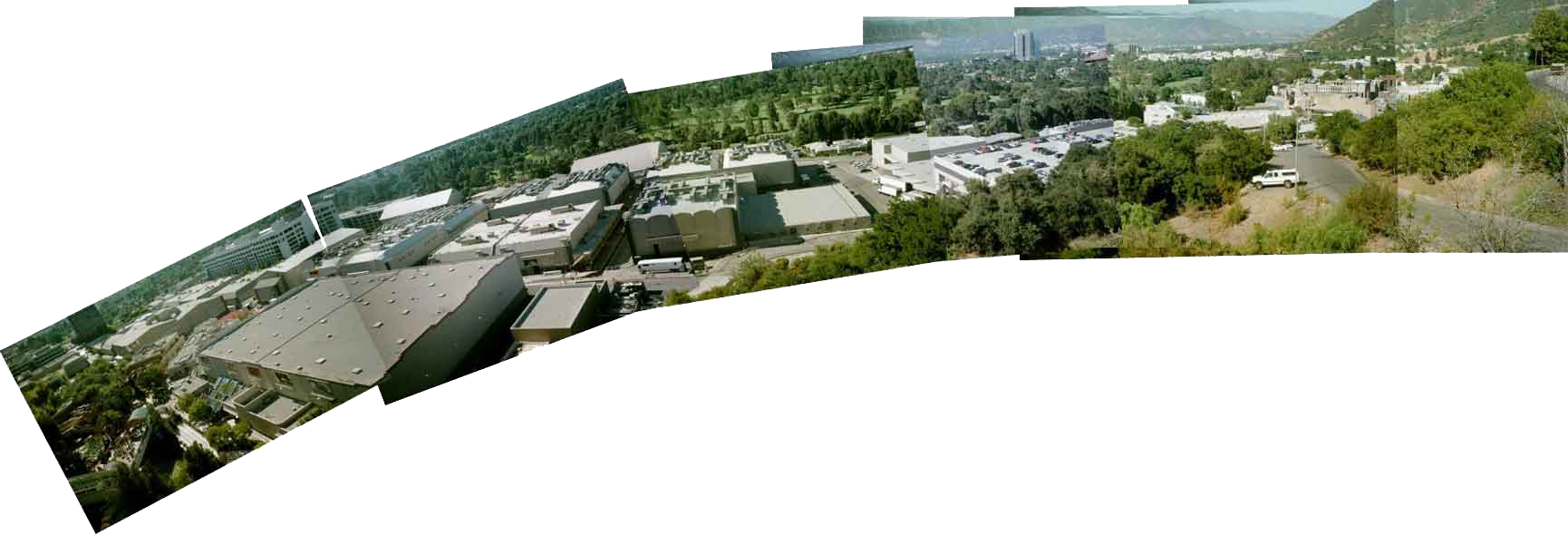
Here's the set-up: As my family descended the escalators to lower Universal Studios to see the BackDraft presentation after riding the Jurassic Park water-coaster, I lingered to take a series of photos of the backlot.
My thought was to capture the whole San Fernando Valley (the view is about 10 miles) in a series, which I would "stitch" together in Photoshop and come out with a nice, long, frameable, panoramic souvenir of our vacation. Hah!
During the shooting, I was careful not to change the level of the camera, which I placed on the studio railing for stability. Independently, each photo looks level. I wasn't prepared for the shock of assembling the panorama.
The surprise came when—in order to match details together—I had to rotate each image slightly, starting at the far right (laying them out from the left proved impossible). The end result was this composite.
When I couldn't get rid of the disturbing gap at the top left, I stopped working. Normally I would blend the levels in Photoshop and made sure it looked like it was one continuous piece.
Later, discussing this with my sister-in-law, we wondered whether I had inadvertently photographed the curvature of the earth. It sure looks like that and if I lied to you, I could probably get away with telling you it was.
Turns out the answer is more prosaic. The camera's film plane is flat. When I rotated the camera slight, the new viewing angle didn't quite match the previous. It's a cumulative thing. The farther right I rotated the camera as I took each picture, the more the overall alignment drifted.
Still, even unfinished, the end result is, won't you admit, a mighty spectacular montage!
For more examples of my composite images, see Bent spires and stained glass windows and "Pick up" band at Golden Gate park
© 2026 Michael Heavener